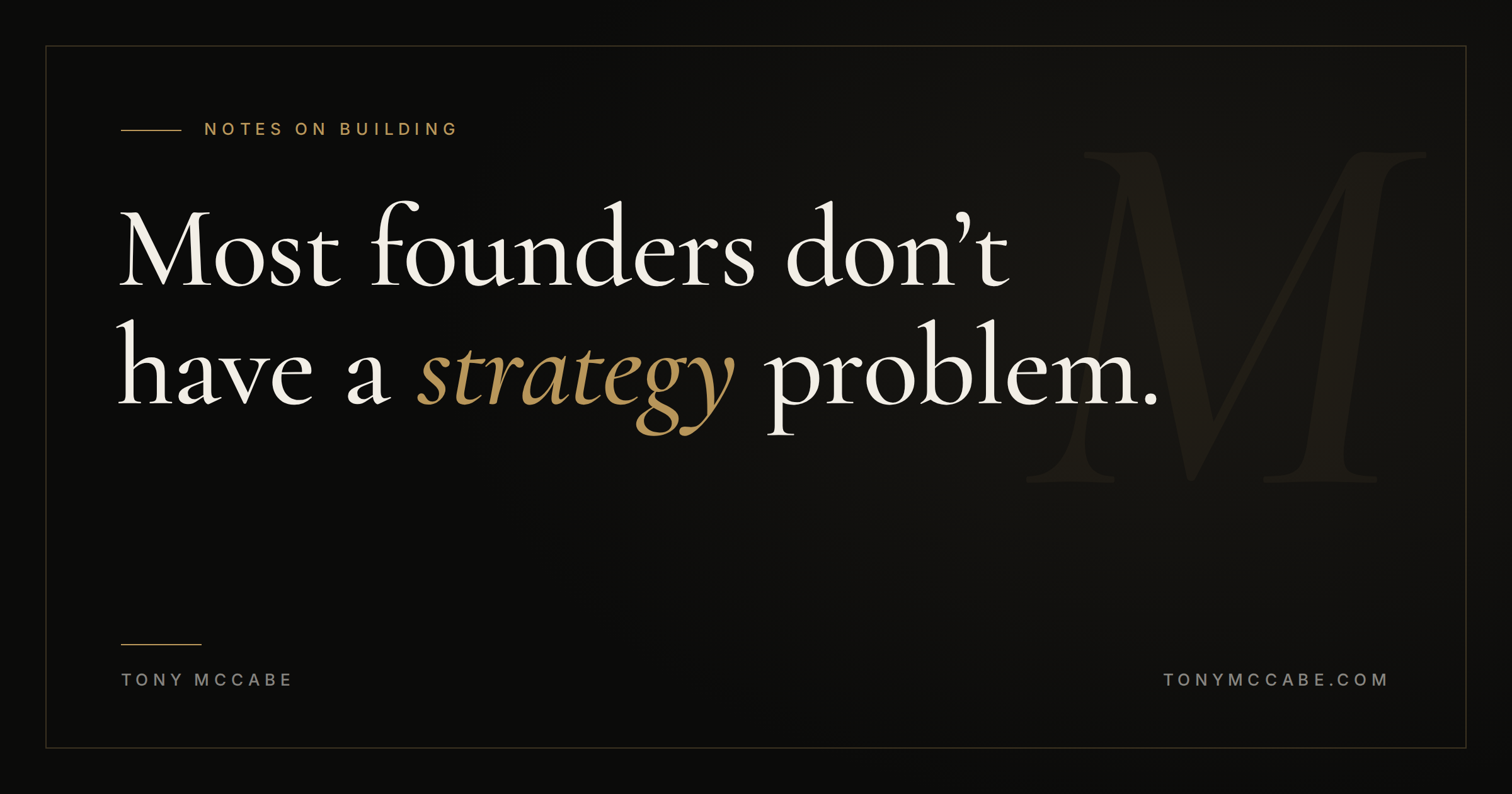
It picks up the line from your About page, makes a claim readers will want to test, and sets up your core idea: the business outgrows the founder before it outgrows the market.
Alternates, if the post has a different angle:
- The Business Is Ready. Are You? — for a post on founder identity and becoming the leader the business needs
- No Decision Is Still a Decision — for a post on stalling, avoidance and momentum
- Built for Founders Who Are Done Talking — for a manifesto or introduction post
Send me the post’s topic or draft and I’ll write a title that fits it exactly, along with the excerpt and meta description.
Most Founders Don’t Have a Strategy Problem give me a good post from your research
The post is below, written in your voice and ready to paste into WordPress. It rests on one verified finding, Noam Wasserman’s Harvard research on founder-CEOs, and invents no anecdotes or client stories.
Most Founders Don’t Have a Strategy Problem
Every founder I talk to thinks their problem is strategy.
They want a better offer. A sharper funnel. A clearer plan for the next quarter. So they buy another course, rework the pricing page, and rewrite the plan they wrote six months ago.
Nothing moves.
The strategy was never the issue. The founder running it was.
The business outgrows you before it outgrows the market
Harvard professor Noam Wasserman studied founders over years of research, and the pattern he found is hard to ignore. Three years in, half of the founders had already stopped being CEO. By year four, only 40% still held the role, and fewer than a quarter were still in charge when their company went public. tradebriefs
Those companies weren’t failing. Many of them were working. The founder simply stopped being the right person to lead what they had built.
Wasserman’s point is that the qualities that get a company started are often not the ones needed to run it as a growing business. The instincts that got you from zero to traction start working against you. Speed turns into chaos. Doing everything yourself turns into a bottleneck. Keeping everything in your head turns into a company only you can run. researchgate
The market didn’t close the door. The founder did.
What it actually looks like
It rarely looks like a crisis. It looks like this:
- Every decision still runs through you.
- You know what needs to change and you keep postponing it.
- Your week gets filled by whoever asks loudest, not by what matters most.
- You’re working harder than you did a year ago for the same results.
- You explain the problems well. You just don’t fix them.
None of these is a strategy problem. They are problems of leadership, of your standards, and of how you decide.
The real problem is decisions left unmade
Most founders don’t make bad decisions. They leave the important ones unmade.
The hire you should have made in spring. The client you should have let go. The offer you should have cut. The price you should have raised. Each one waits, and every week it waits costs more than a bad decision would have.
A founder who decides well with an average strategy will beat a founder who hesitates with a brilliant one. Every time.
Becoming the founder the business needs
The work is not to find a better plan. It is to become the person who carries out the plan you already have.
That comes down to three things:
Accountability. You’re measured on what shipped, not what you understood. Understanding the problem feels like progress. It isn’t.
Precision. Fewer priorities, held longer. One decision made properly beats ten made quickly.
Momentum. Progress compounds, and so does avoidance. Every week you delay a hard call makes the next one harder.
Where to start
Before you touch your strategy again, answer one question honestly:
What is the one decision I already know I need to make, and haven’t?
Write it down. Put a date on it. Make it this week.
That’s not the whole solution. But it’s the first real move most founders haven’t made.
— Tony
If you know the business is ready and you’re not, that’s the work I do. Book a call.
Leave a Reply